Armor of God's Knights Faith & Fortitude
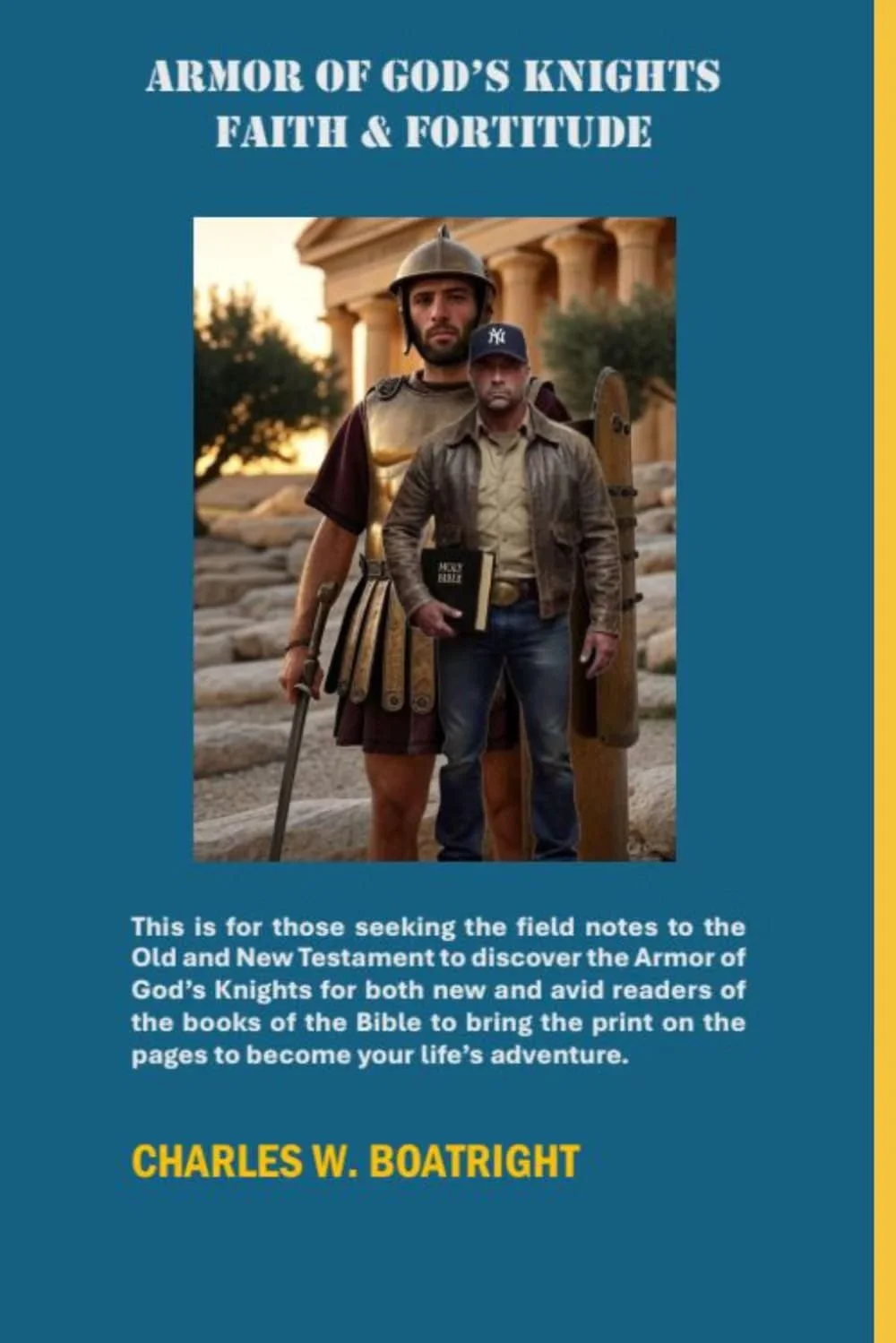

Armor of God's Knights Faith & Fortitude
There are stories that sit quietly on a shelf until someone opens them and finds they were never meant to be quiet. Armor of God’s Knights: Faith & Fortitude, by Charles Boatright, treats the pages of the Old and New Testaments that way. It is written as field notes for both new and avid readers, a practical guide that crosses references people and events so the print on the page can become a life adventure.
Part of what Boatright calls the Field Note Series, the book aims at the same sense of wonder George Lucas and Steven Spielberg brought to familiar biblical artifacts in Raiders of the Lost Ark and Indiana Jones and the Last Crusade. The Ark of the Covenant, in that telling, was never merely a golden box; it was the mercy seat of God. Boatright’s project is to recover a comparable sense of expedition inside Scripture itself.
The organizing image is the armor of God. Drawing on Isaiah 59:17 and the familiar inventory in Ephesians 6, the book presents biblical figures as knights equipped for trials that look, in their essentials, much like the pressures people face now. Truth buckled on, righteousness in place, readiness that comes from the gospel of peace, the shield of faith, the helmet of salvation, and the sword of the Spirit—the Word of God—are not abstract slogans here.
These warriors are ordinary and unlikely people equipped with the Word of God that stood their ground. Boatright’s method is to compile brief, interconnected accounts of those people, supplying historical and cultural context so the stories lock together rather than float as isolated episodes.
Readers who once relied on study aids for difficult classics will recognize the approach: something like field notes or a Cliffs Notes companion, built to interconnect scriptural narratives and to show how ancient challenges mirror modern events.
The lineage that runs through Judah, Leah’s fourth son, supplies one of the book’s more compelling threads of intrigue. From that line come David and, later, Jesus Christ, and the ancestry is not a tidy genealogical chart.
It includes figures such as Abraham and Sarah, whose origins lie in what is now Iraq, and others such as Tamar, Rahab, and Salmon—names that place Canaanite and wider Mesopotamian histories inside the story of Israel. Boatright treats those intersections as part of the adventure, not as footnotes to be skipped.
Elsewhere the book moves through episodes that reward the same cross-referenced reading: Jeremiah’s promise of a new covenant written on hearts, the story of Esther and the preservation of a people in exile in Persia, and the pattern, repeated across the canon, of failures that become experience and successes that build confidence. The tone is that of an expedition narrative rather than a systematic theology. Conditions and distractions change; the objective does not.
Faith, in this framing, is close to perseverance. Boatright invites readers who know sportsmanship, training, and the long race to hear the biblical language that way: integrity under pressure, the refusal to treat yesterday’s miss as the end of the contest, the decision described in Philippians 3 to forget what lies behind and press toward what lies ahead. The knights of the title are not romantic ornaments.
They are people who needed structure in chaotic circumstances and found it in the equipment God supplied. The book, running roughly four hundred pages and offered for readers from later childhood through the teen years as well as for adults, is aimed especially at Generations X and Z—readers who may know the films better than the source texts and who can use a guide that treats Scripture as an adventure of discovery rather than a closed archive.
What follows in these pages is therefore an invitation to read with both map and compass: cross-references in one hand, the armor’s pieces in view, and the willingness to let historical detail sharpen rather than dull the story. The field notes do not replace the texts they annotate. They are written so that the people and events that shaped biblical history can be encountered again as a journey of faith and fortitude—one in which the reader is expected to notice the Armor of God protection and use it in their daily life.