SCARLETT BANNER: MOSSAD’S PANTHER SQUAD
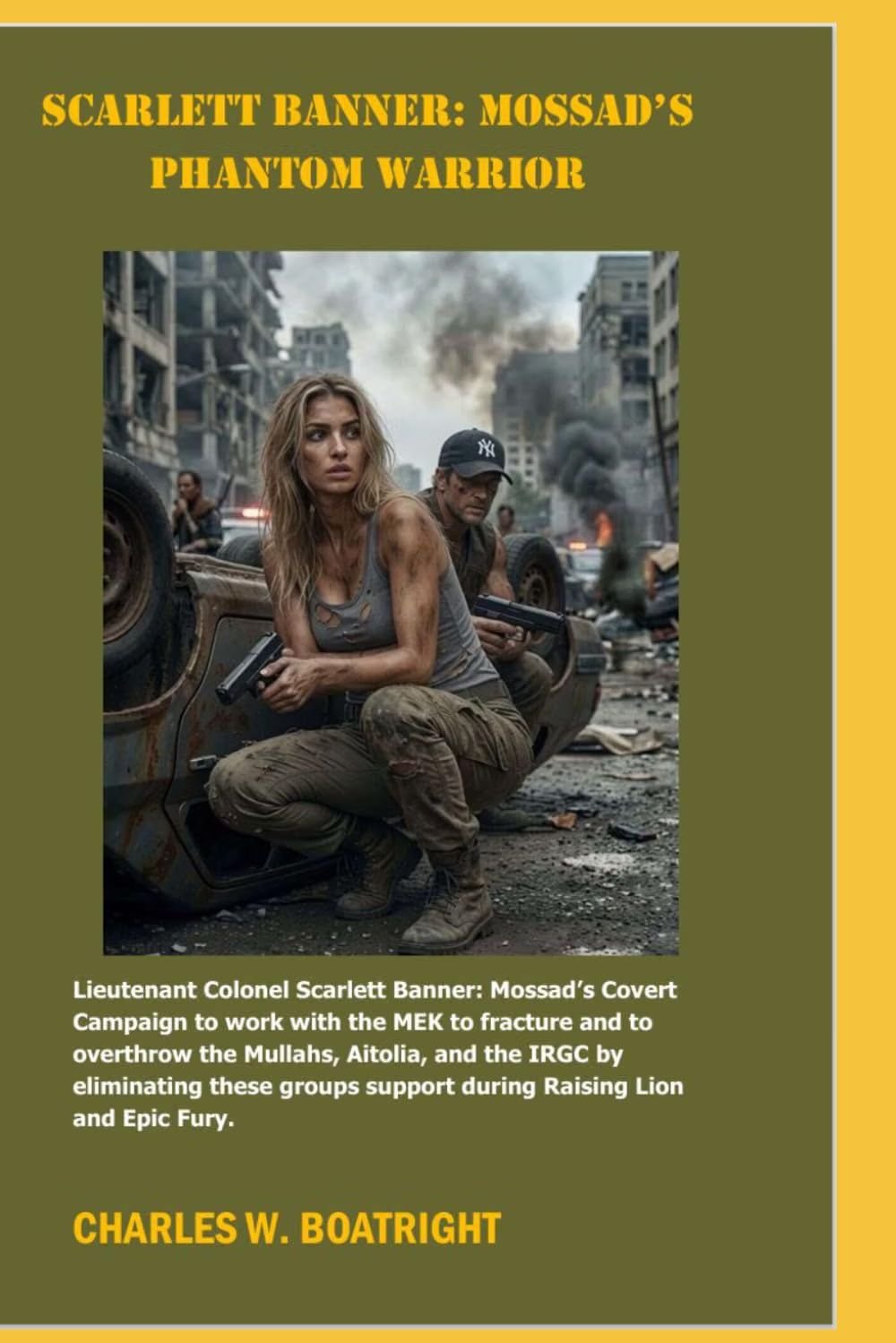


SCARLETT BANNER: MOSSAD’S PANTHER SQUAD, by Charles W. Boatright
In the shadows of a fracturing Iran, Scarlett Banner: Mossad’s Panther Squad written by Charles W. Boatright follows Lieutenant Colonel Scarlett Banner into a covert campaign meant to crack the pillars of a theocratic state from within Iran.
The novel places her at the center of a joint effort linking Mossad, American special operations, and Iranian defectors, with cooperation from elements of the MEK, as pressure builds against the mullahs, the clerical authority around the Ayatollah, and the Islamic Revolutionary Guard Corps. It is a story of deniable work, shifting loyalties, and the narrow space between a regime that still holds the guns and a society that has begun to pull away from it.
Boatright opens the campaign after the January 2026 protests and the killing of medical staff, a moment when the IRGC is no longer presented as a single unbroken force. Operation Epic Fury begins with a midnight call. Banner, fluent in Persian and shaped by Sayeret Matkal (a unit here both Benjamin Netanyahu, Bibi, and his brother, Yonatan "Yoni" Netanyahu, served with) service, parachutes into Drop Zone Bravo near Tehran.
There she links with Maryam Rezaei, the Iranian defector known as Reza. Together they approach disaffected non-commissioned officers, offering immunity and a place in a transitional future rather than a public alliance with foreign powers. The rebellion is meant to look Iranian-led. Cells form. Loyalist officers are isolated. Weapons depots are seized. Guerrilla networks are armed. In the book’s account, the work moves faster than planned, and the regime begins to turn on itself.
The title’s Panther Squad is the tighter formation that emerges once the first phase succeeds and the fight changes shape. Redesignated as bounty hunters, Scarlett and Maryam pursue fleeing senior officers across borders. In Istanbul they take a general tied to assassination networks.
In Budapest they join U.S. Colonels Chuck Erickson and Levi Strauss, and the pair expands into a six-person team. From that point the novel moves between European cities, Caspian freighters, and the ridges of the Zagros, tracking IRGC figures who try to embed under foreign cover, including Russian protection. The missions remain deniable. Their stated aim is to stop the export of extremism and to defend four freedoms: speech, worship, freedom from want, and freedom from fear.
Banner herself is drawn as a professional rather than a symbol. Her advantage is language, patience, and the ability to operate without announcing who holds the lever. The book treats partnership with Iranian defectors and MEK-linked networks as a political and operational gamble: useful against the mullahs and the IRGC, but never free of old grievances or competing claims on the country that would follow. Fracture is the method. Overthrow is the horizon. Neither is presented as clean.
Boatright writes the introduction’s promise in the pace of a thriller and the furniture of a campaign narrative. Readers are asked to follow a small team as it tries to make a large regime consume its own chain of command, then to chase the remnants before they rebuild abroad. The Panther Squad is small by design. Its leverage comes from timing, local allies, and the cracks already running through the Guard and the clerical state.
Scarlett Banner: Mossad’s Panther Squad offers that campaign as fiction rooted in a real recognizable struggle: who will define Iran once the instruments of fear begin to fail, and what it costs the people sent to hasten that failure.